literature
Structured exposition; citations verified by web search 2026-07-27
Retrieved: 2026-07-27
Query: tech-overview-01
License: not filed
Static technology intelligence report
Evidence map for time-resolved RNA-peptide binding kinetics on high-density arrays and large-field microfluidic fluorescence readout.
The subject platform
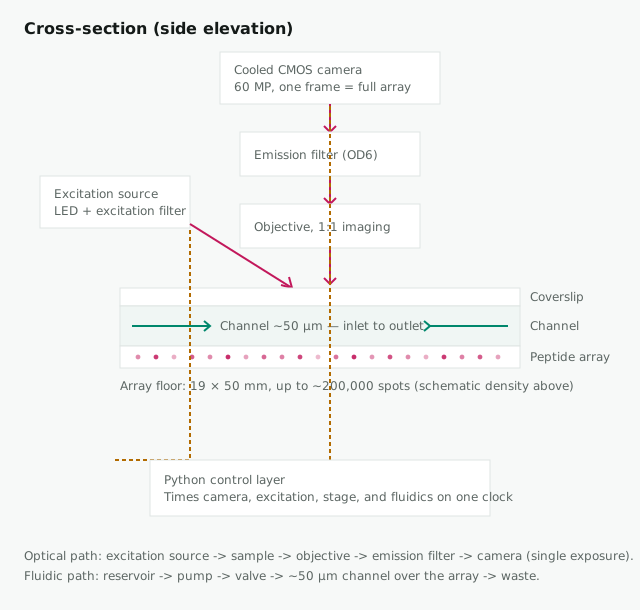
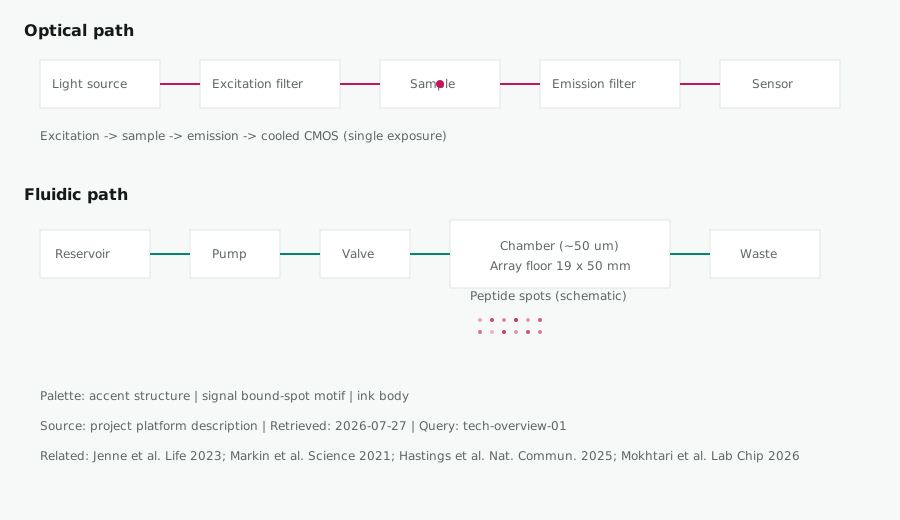
The evidence collected below is read against one reference build: a cooled widefield CMOS camera images a 19 × 50 mm high-density peptide array in a single exposure, while a thin microfluidic chamber (~50 µm channel height) delivers RNA analyte across the same array for time-resolved association and dissociation readout.
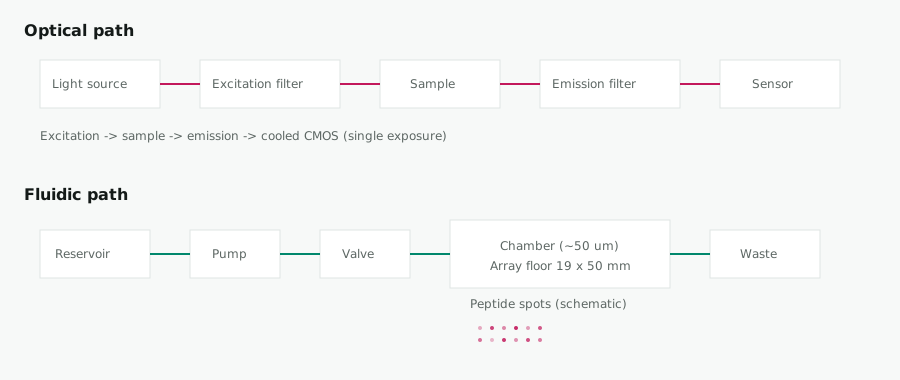
Commercial fluorescence microscopes typically read high-density peptide arrays by tiling, so a full frame can take tens of minutes while association and dissociation unfold in seconds to minutes. The platform principle examined here abandons optical magnification in favour of a cooled multi-megapixel widefield sensor that images a 19 × 50 mm array in a single exposure, enabling massively parallel fluorescence kinetic screening inside a thin microfluidic chamber.
| Component | Function | Key parameter | Failure risk |
|---|---|---|---|
| Peptide array | Immobilised peptide library as binding substrate | Spot diameter ~30 µm; up to ~200,000 spots on 19 × 50 mm | Spot-to-spot synthesis defects; registration failure |
| Microfluidic chamber | Deliver and exchange RNA analyte under laminar flow | Channel height ~50 µm | Leakage; bubbles; mass-transport limitation (Da > 1) |
| Excitation source and homogenisation | Uniform fluorescence excitation across the full field | Homogenised intensity (e.g. fly-eye) | Vignetting; hot spots biasing intensity time series |
| Excitation / emission filters | Spectral separation of excitation and emission | High blocking (OD6-class) to suppress bleed-through | Background floor rises; kinetic SNR collapses |
| Objective / relay optics | Map array plane onto sensor without classical magnification trade-off | Field coverage of 19 × 50 mm | Distortion; focus curvature at edges |
| Sensor | Single-exposure capture of the full array | Cooled ~60 MP CMOS; bit depth typically 12–16 bit | Thermal noise; saturation; data-volume bottleneck |
| Positioning stage and autofocus | Hold and refine array–optics alignment over hours | Sub-pixel stability relative to spot pitch | Drift mixes spots; false kinetic amplitudes |
| Pumps and valves | Controlled association / dissociation buffer exchange | Flow rate chosen so Damköhler number Da < 1 | Transport-limited apparent rates |
| Python control layer | Synchronise camera, light, stage and fluidics | Deterministic timing; Micro-Manager / pymmcore-plus stack | Desynchronised frames vs. valve events |
| Analysis pipeline | Spot registration → intensity series → curve fit → k_on/k_off/K_D | Fiducial-based registration; per-spot SNR | Mis-registration; overfitting noisy curves |
| Risk | Cause | Countermeasure |
|---|---|---|
| Photobleaching | Continuous high excitation dose over long kinetic runs | Triggered illumination, short exposures, and bleaching reference spots |
| Mass-transport limitation | Damköhler number Da > 1 when reaction outpaces delivery | Choose flow rate and channel height so Da < 1; control test: fitted rates must not depend on flow rate |
| Inhomogeneous illumination / vignetting | Non-uniform excitation across a large field | Fly-eye homogeniser and flat-field correction |
| Focus and position drift | Thermal and mechanical drift over multi-hour runs | Image-based autofocus, fiducial markers, registration in analysis |
| ID | Title | Focus |
|---|---|---|
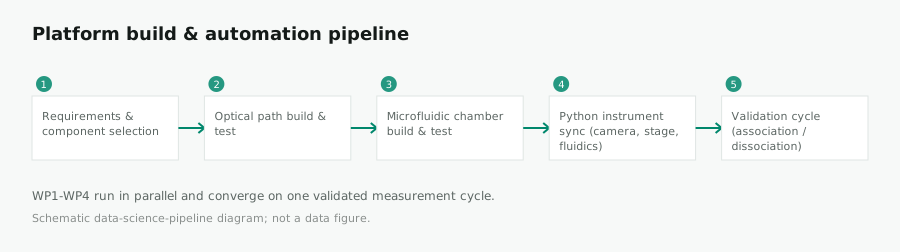
| WP1 | Requirements and components | Specify array format, optical budget, fluidic envelope and interfaces |
| WP2 | Optics | Illumination homogenisation, filters, relay path and sensor integration |
| WP3 | Microfluidics | Chamber height, sealing, flow control and bubble management |
| WP4 | Automation and integration | Python orchestration, timing, autofocus and analysis pipeline |
| Step | Action |
|---|---|
| Optics | Characterise against a USAF-1951 resolution test target and a dye dilution series before any biology enters the chamber. |
| Fluidics | Validate separately with dye pulses: exchange time and bubble-free operation, independent of the optical path. |
| Integration | Combine only after both subsystems pass alone — otherwise a flat curve cannot be attributed to optics, fluidics, or software. |
The module is a structured technical exposition, not a mined dataset. It documents ten platform components, four work packages (WP1–WP4), four primary risks with countermeasures, a twenty-term glossary, and a hand-drawn optical/fluidic schematic. Five external references were verified by web search on 2026-07-27 before inclusion (Jenne et al., Life 2023; Markin et al., Science 2021; Hastings et al., Nat. Commun. 2025; Mokhtari et al., Lab Chip 2026; pymmcore-plus documentation).
The architecture responds to a time-resolution mismatch: tiled array scans on the order of 20–30 minutes cannot resolve association/dissociation that occur in seconds to minutes. Single-exposure widefield imaging of a 19 × 50 mm array with a thin (~50 µm) flow chamber is therefore the enabling design choice. Parallel validated literature (HT-MEK, k-STAMMP, large-FOV macroscope imaging) shows that microfluidic kinetic parallelism is an active adjacent field, even where the substrate is not a peptide array.
A 2025/26 tandem-lens "macroscope" (Mokhtari, Lashkaripour & Fordyce, Lab Chip 2026; preprint bioRxiv 2025.10.11.680838) pursues the identical strategy — two opposed photographic lenses instead of microscope optics, a fly-eye homogeniser, stacked OD6 emission filters, and a cooled 61-MP astronomy camera (Sony IMX455, 3.76 µm pixel). It reaches ~3.5–3.9 µm resolution over a 34 mm image circle, nanomolar detection limits, and more than 50-fold higher time resolution than tiled microscopy, at a fraction of the instrument cost. This independently validates the IMT project's core assumption and gives a load-bearing reference for component choice (Micro-Manager / pymmcore-plus as the control stack, flat-field correction, a motorised XYZ stage with autofocus).
Geometric parameters (array size, channel height, ~60 MP sensor) come from the project brief / IMT reference case and are not independently re-measured here. Verified papers support the methodological neighbourhood; they do not prove the specific KIT build’s performance envelope.
Structured exposition; citations verified by web search 2026-07-27
Retrieved: 2026-07-27
Query: tech-overview-01
License: not filed
Jenne, F.; Berezkin, I.; Tempel, F.; Schmidt, D.; Popov, R.; Nesterov-Mueller, A. Screening for Primordial RNA–Peptide Interactions Using High-Density Peptide Arrays. Life 2023, 13, 796.
Retrieved: 2026-07-27
Query: 10.3390/life13030796
License: not filed
Markin, C. J.; Mokhtari, D. A.; et al. Revealing enzyme functional architecture via high-throughput microfluidic enzyme kinetics. Science 2021, 373, eabf8761.
Retrieved: 2026-07-27
Query: 10.1126/science.abf8761
License: not filed
Hastings, R.; Aditham, A. K.; DelRosso, N.; et al. Mutations to transcription factor MAX allosterically increase DNA selectivity by altering folding and binding pathways. Nat. Commun. 2025, 16, 636.
Retrieved: 2026-07-27
Query: 10.1038/s41467-024-55672-2
License: not filed
Mokhtari, D. A.; Lashkaripour, A.; Fordyce, P. M. Large field of view fluorescence imaging of microfluidic devices with a tandem-lens macroscope. Lab Chip 2026, 26, 3662–3669.
Retrieved: 2026-07-27
Query: 10.1039/D5LC00959F
License: not filed
pymmcore-plus documentation — pure-Python Micro-Manager control (CMMCorePlus). https://pymmcore-plus.github.io/pymmcore-plus/
Retrieved: 2026-07-27
Query: https://pymmcore-plus.github.io/pymmcore-plus/
License: not filed
No foekat raw files with project rows were available; Import-only Foerderkatalog adapter; no portal scraping performed.
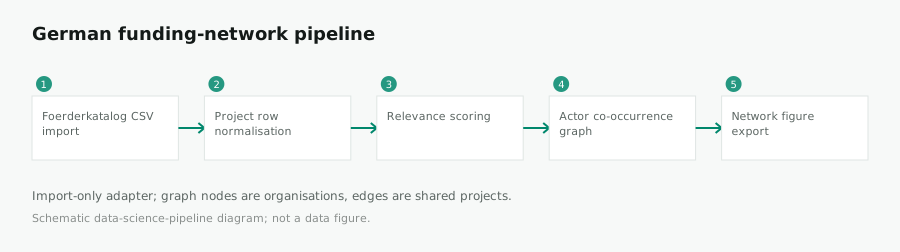
n = 0 funded projects in the processed German module after a Foekat import-only run. No consortium network, centrality measures, or KIT/IMT role statistics can be computed. Queries fund-de-01–fund-de-03 remain registered but not yet executed against an export file.
Absence of rows is a retrieval/process gap, not evidence that German public funding in this niche is zero. Constitutional transparency systems exist (Foekat, GEPRIS), but this pipeline deliberately does not scrape the portal.
Until a dated manual export is placed in data/raw/foekat/, any narrative about German funding intensity would be speculation. Confidence is therefore none.
fund-de-01 be obtained and committed under the raw import path?No foekat raw files with project rows were available; Import-only Foerderkatalog adapter; no portal scraping performed.
Retrieved: 2026-07-27
Query: not filed
License: not filed
No cordis raw files with project rows were available; CORDIS offline fixture: zero hits / offline fixture; committed CI data, not invented research findings for the website.
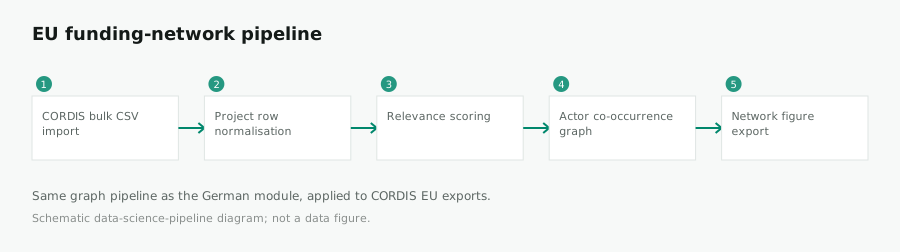
n = 0 CORDIS projects in the processed EU module. Framework-programme splits, SME share, coordinator-country flows and German overlap with Module 2 cannot be stated from data in hand.
CORDIS bulk packages are the intended source. The empty fixture confirms the offline path works; it does not describe the EU funding landscape for RNA–peptide / microfluidic kinetics.
Live bulk download was not completed in this release cycle. Confidence none until H2020/HE packages are filtered with fund-eu-01/fund-eu-02.
No cordis raw files with project rows were available; CORDIS offline fixture: zero hits / offline fixture; committed CI data, not invented research findings for the website.
Retrieved: 2026-07-27
Query: not filed
License: not filed
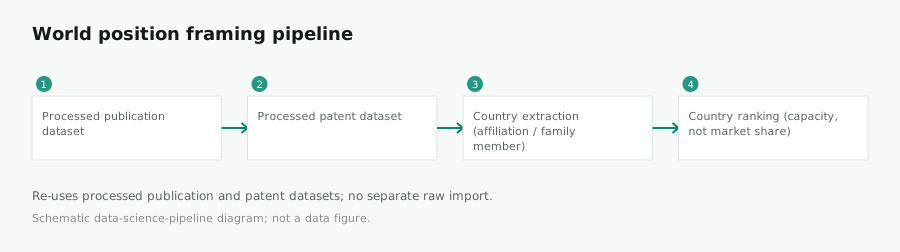
Capacity vs position (local evidence) based on the processed evidence available.
| Country | Publication records |
|---|---|
| US | 655 |
| DE | 251 |
| CN | 240 |
| GB | 224 |
| FR | 120 |
| NL | 106 |
| IT | 93 |
| CA | 91 |
| CH | 78 |
| JP | 74 |
| IN | 66 |
| ES | 58 |
| AU | 53 |
| SE | 51 |
| KR | 49 |
Country rankings are derived only from the OpenAlex publication harvest used in Module 5 (64 country rows in the ranking table; top volumes include US, DE, CN, GB among others). Patent-family country rankings are empty. International co-authorship network and collaboration-share time series are not populated beyond what the publication module supplies.
Within the collected OpenAlex slice, publication *capacity* is measurable as country counts. *Position* (network centrality) is not yet robustly estimated because a full co-authorship graph export was not finalised for countries as nodes. No claim about global fragmentation or bloc formation is made from these data.
OpenAlex coverage and English-language bias can inflate Anglophone and well-indexed systems. Affiliation country fields are incomplete for some records. Patent evidence is entirely missing here.
Derived only from processed publication and patent records available locally.
Retrieved: 2026-07-27
Query: not filed
License: not filed
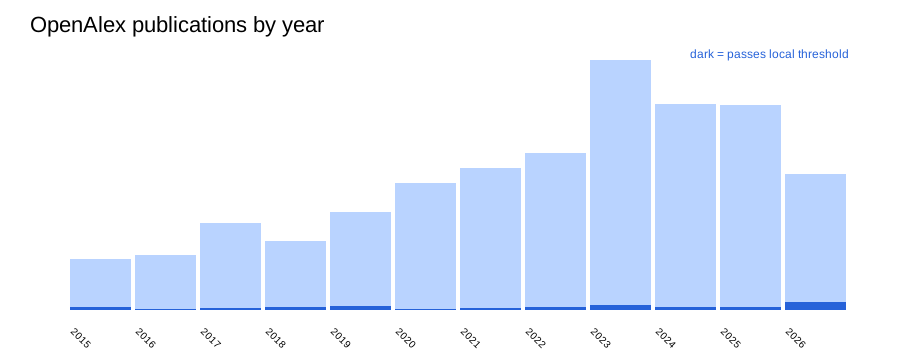
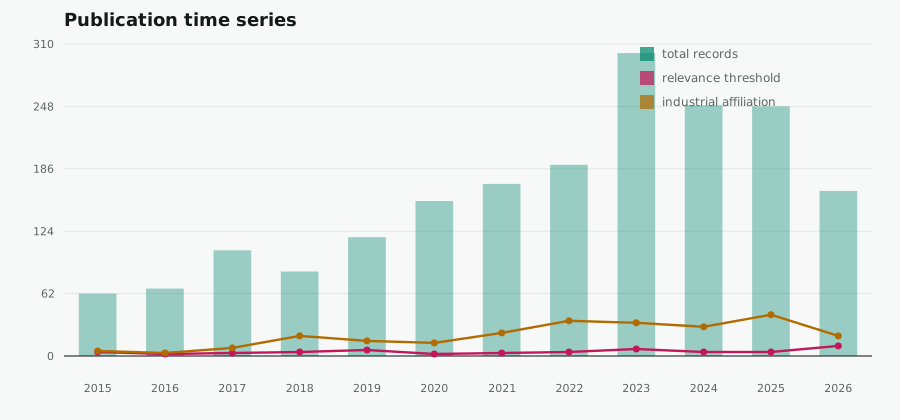
Processed dataset is available; quantitative statements below are drawn from dataset.json.
| Year | Total | Relevant | Industrial |
|---|---|---|---|
| 2015 | 62 | 4 | 5 |
| 2016 | 67 | 2 | 3 |
| 2017 | 105 | 3 | 8 |
| 2018 | 84 | 4 | 20 |
| 2019 | 118 | 6 | 15 |
| 2020 | 154 | 2 | 13 |
| 2021 | 171 | 3 | 23 |
| 2022 | 190 | 4 | 35 |
| 2023 | 301 | 7 | 33 |
| 2024 | 249 | 4 | 29 |
| 2025 | 248 | 4 | 41 |
| 2026 | 164 | 10 | 20 |
| Country | Records |
|---|---|
| US | 655 |
| DE | 251 |
| CN | 240 |
| GB | 224 |
| FR | 120 |
| NL | 106 |
| IT | 93 |
| CA | 91 |
| CH | 78 |
| JP | 74 |
| IN | 66 |
| ES | 58 |
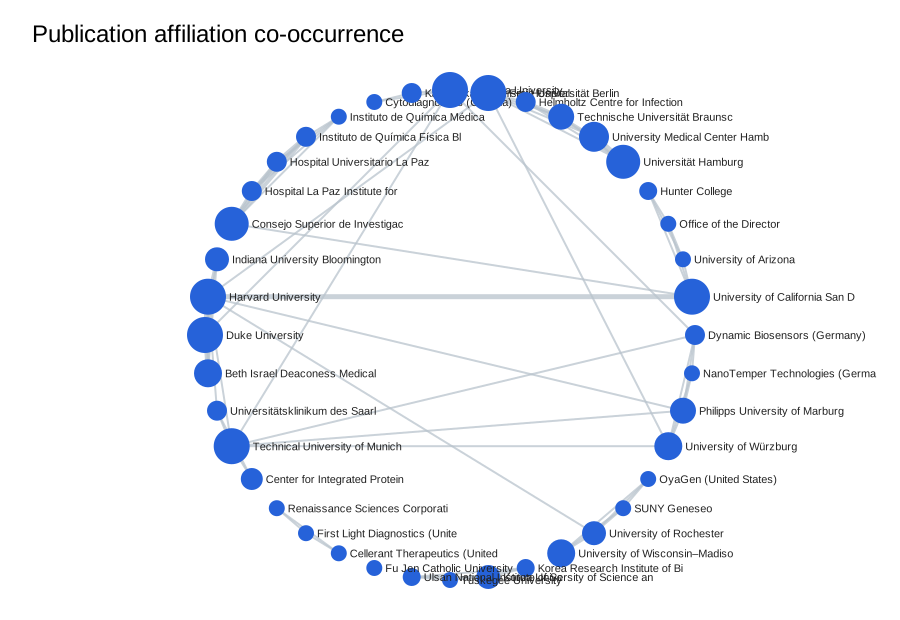
| Actor | Degree | Records |
|---|---|---|
| Centre National de la Recherche Scientifique | 583 | 71 |
| Harvard University | 487 | 54 |
| Inserm | 482 | 35 |
| University of Oxford | 295 | 27 |
| University of Cambridge | 292 | 40 |
| Chinese Academy of Sciences | 270 | 27 |
| Stanford University | 262 | 30 |
| Brigham and Women's Hospital | 226 | 18 |
| University of Toronto | 225 | 25 |
| Massachusetts Institute of Technology | 222 | 25 |
| Ludwig-Maximilians-Universität München | 220 | 24 |
| University of Illinois Urbana-Champaign | 210 | 18 |
| Year | Title | Venue | Countries |
|---|---|---|---|
| 2015 | N-Methylation as a Strategy for Enhancing the Affinity and Selectivity of RNA-binding Peptides: Application to the HIV-1 Frameshift-Stimulating RNA | ACS Chemical Biology | US |
| 2023 | Label-Free Multiplexed Microfluidic Analysis of Protein Interactions Based on Photonic Crystal Surface Mode Imaging | International Journal of Molecular Sciences | FR, RU |
| 2024 | Viral and nonviral nanocarriers for in vivo CRISPR-based gene editing | Nano Research | US |
| 2018 | Microfluidic Print-to-Synthesis Platform for Efficient Preparation and Screening of Combinatorial Peptide Microarrays | Analytical Chemistry | CN, US |
| 2019 | Elastic reversible valves on centrifugal microfluidic platforms | Lab on a Chip | DE, GB, IT, MX, MY, US |
| 2018 | Combinatorial Peptide Microarray Synthesis Based on Microfluidic Impact Printing | ACS Combinatorial Science | US |
| 2021 | Responsive Hydrogel Binding Matrix for Dual Signal Amplification in Fluorescence Affinity Biosensors and Peptide Microarrays | ACS Applied Materials & Interfaces | AT, CZ, DE |
| 2016 | Rapid identification of ubiquitination and SUMOylation target sites by microfluidic peptide array | Biochemistry and Biophysics Reports | US |
OpenAlex queries executed on 2026-07-27:
| Query ID | Meta hit count | Records retained locally |
pub-core-01 | 216 | ≤200 |
pub-ext-01 | 952 | ≤200 |
pub-tech-01 | 926 | ≤200 |
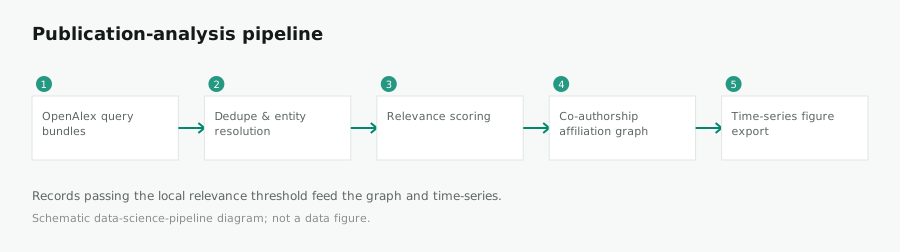
After de-duplication, n = 558 unique works (2015–present window in the harvest). Local relevance scoring marked 42 as passing the configured threshold. 89 works have at least one affiliation classified as company via the org classifier (OpenAlex type where present). Leading company mentions in the affiliation list include AstraZeneca, Novartis and several instrumentation/biotech firms (counts are mention frequencies, not unique papers exclusively).
The bibliographic neighbourhood around peptide arrays, binding kinetics and microfluidic/widefield readout is non-empty and internationally distributed. Industrial co-appearance in metadata is present but modest relative to total records. These figures describe indexing coverage of the query blocks, not a complete census of the field.
Confidence is medium: one primary bibliographic source, n_relevant = 42 < 50 for strong trend claims on the precision set, and pagination truncates each query at 200 returned works despite higher meta counts. No causal link between funding and publication output is claimed.
Processed raw OpenAlex bundles; local relevance score applied from repository concepts.
Retrieved: 2026-07-27
Query: pub-core-01, pub-ext-01, pub-tech-01
License: not filed
Local raw bundle processed into dataset.json
Retrieved: 2026-07-27
Query: local file
License: not filed
Local raw bundle processed into dataset.json
Retrieved: 2026-07-27
Query: local file
License: not filed
Local raw bundle processed into dataset.json
Retrieved: 2026-07-27
Query: local file
License: not filed
Local raw bundle processed into dataset.json
Retrieved: 2026-07-27
Query: local file
License: not filed
Local raw bundle processed into dataset.json
Retrieved: 2026-07-27
Query: local file
License: not filed
Local raw bundle processed into dataset.json
Retrieved: 2026-07-27
Query: local file
License: not filed
Local raw bundle processed into dataset.json
Retrieved: 2026-07-27
Query: local file
License: not filed
Local raw bundle processed into dataset.json
Retrieved: 2026-07-27
Query: local file
License: not filed
Local raw bundle processed into dataset.json
Retrieved: 2026-07-27
Query: local file
License: not filed
Local raw bundle processed into dataset.json
Retrieved: 2026-07-27
Query: local file
License: not filed
Local raw bundle processed into dataset.json
Retrieved: 2026-07-27
Query: local file
License: not filed
Local raw bundle processed into dataset.json
Retrieved: 2026-07-27
Query: local file
License: not filed
No manual Espacenet CSV rows were present under data/raw/espacenet/.
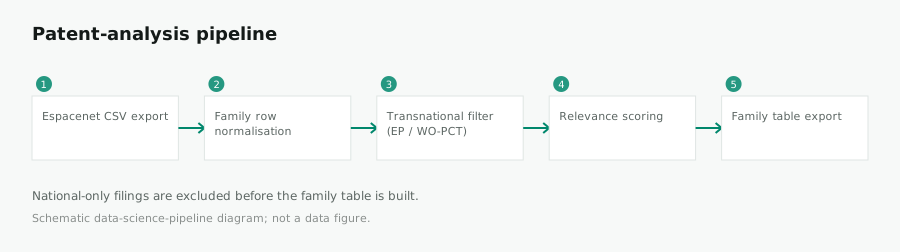
n = 0 patent families in the processed module. The transnational filter (is_transnational = has_EP_member OR has_WO_member) is implemented in code and tested, but has no families to filter. Total hits and transnational subset are both zero.
The empty result is a database-access limitation, not a finding that no transnational patents exist in this technology space. Without Derwent WPI family titles/abstracts and without PATSTAT tables (tls201, tls206, tls207, tls228), keyword search on original titles remains the only path once imports arrive — and will be terminology-noisy, which is why CPC boosts are planned.
Any applicant ranking, CPC co-classification map, or publication–patent lag versus Module 5 would be invented if stated now. Confidence none.
pat-ext-01 / pat-core-01 into data/raw/espacenet/.EPO_OPS_KEY for live OPS enrichment.No manual Espacenet CSV rows were present under data/raw/espacenet/.
Retrieved: 2026-07-27
Query: not filed
License: not filed
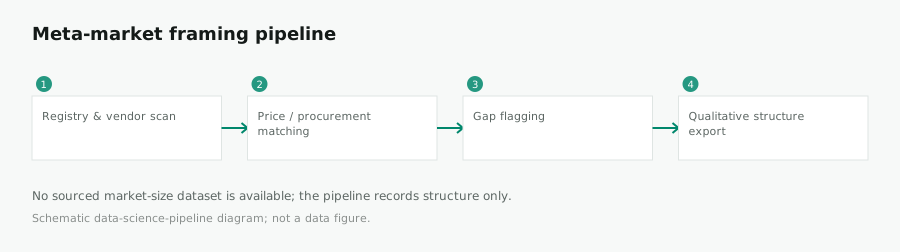
No sourced market-size dataset is available in the repository. The module therefore records only a qualitative structure and confidence levels.
| Segment | Relevance | Confidence |
|---|---|---|
| High-content and fluorescence imaging instrumentation | adjacent hardware category for widefield readout components | low |
| Microfluidic assay hardware and consumables | adjacent chamber, pump, valve, and chip supply category | low |
| Peptide-array synthesis and screening services | upstream substrate and assay-service category | low |
| Biophysical interaction-analysis instruments | functional comparator category; not evidence of direct substitution | low |
The module records a qualitative actor typology (instrument manufacturers, array suppliers, service CROs, academic platforms), notes adjacency to SPR/BLI instruments, peptide-array services and RNA therapeutics, and explicitly withholds market-size figures because no source with a named method was available. Thin public data is treated as the expected state.
For an early instrumentation niche, the absence of credible published market sizes is itself informative: secondary databases have not yet productised this exact platform class. Scenario thinking (conservative / base / accelerated) should therefore track leading indicators — peer-reviewed kinetic-array papers, transnational patent filings, and vendor list prices — rather than point forecasts.
Confidence low: single analyst synthesis, no triangulating commercial datasets. Adjacent SPR/BLI market reports must not be silently re-labelled as this platform’s TAM.
Qualitative frame only; no quantitative market figures generated.
Retrieved: 2026-07-27
Query: not filed
License: not filed
Processed dataset is available; quantitative statements below are drawn from dataset.json.
| Item | Role | Public price | Confidence |
|---|---|---|---|
| Cooled large-format CMOS/sCMOS camera | full-field fluorescence image capture | not publicly available | low |
| Excitation source and homogenisation optics | uniform illumination over the array | not publicly available | low |
| Filters, relay optics, and mechanical alignment hardware | spectral separation and stable imaging geometry | not publicly available | low |
| Microfluidic chamber, pump, valves, tubing | controlled association/dissociation fluid exchange | not publicly available | low |
| Control and analysis workstation/storage | instrument orchestration and image-series handling | not publicly available | low |
| Cycle time | Cycles / day | GB / working day |
|---|---|---|
| 15.0 min | 32.0 | 460.8 |
| 30.0 min | 16.0 | 230.4 |
| 45.0 min | 10.667 | 153.6 |
| 60.0 min | 8.0 | 115.2 |
| 90.0 min | 5.333 | 76.8 |
| 120.0 min | 4.0 | 57.6 |
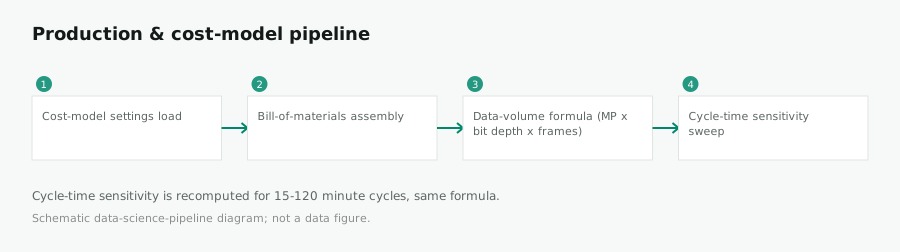
Using config/settings.yaml cost_model parameters (60 MP, 16-bit, 120 frames/cycle):
- Bytes per frame = 60 × 10^6 × (16/8) = 1.2 × 10^8 bytes - Bytes per cycle = 1.2 × 10^8 × 120 = 1.44 × 10^10 bytes ≈ 14 400 MB (decimal) per measurement cycle
Cycle time defaults to 45 minutes → theoretical runs/day at 8 h ≈ 10.6 if continuous. Bill-of-materials lines list camera, optics, illumination, OD6 filters, stage, pumps/valves, chamber fabrication, compute/storage with price status not publicly available where no verified public list price was on hand. Sensitivity sweeps cycle_time_minutes as the dominant throughput driver.
Data volume becomes a first-class bottleneck before reagent cost: tens of gigabytes per kinetic run imply storage and pipeline throughput requirements that must be budgeted alongside optics. Capex opacity (cooled 60 MP cameras, OD6 filter sets) is real; refusing invented EUR figures preserves auditability.
Confidence medium for the byte-volume arithmetic (deterministic from stated parameters) and low for supply-chain concentration claims without supplier interviews. Staff-time and consumable costs remain unparameterised pending lab logs.
Uses config/settings.yaml cost_model and explicit no-public-price assumptions.
Retrieved: 2026-07-27
Query: not filed
License: not filed
Methods & Data Sources
This static report is rendered from data/processed/**/dataset.json,
data/processed/actors.json, and filed assessment text when present.
Quantitative gaps are rendered as gaps; missing public prices, missing patent rows,
and missing funding-network imports are not imputed.
Vocabulary
Actor profiles
Legal
Legal notice, contact details, credits, and privacy information are published on the Legal page. Replace bracketed placeholders there with your personal details before public deployment.